






PIR or EPS roof cores: how to compare sandwich panels
Sandwich-panel roofs and buildings
Compare PIR and EPS cores using the declared performance of complete roof sandwich panels, not figures for loose insulation boards. U-values, weight, available thicknesses and supporting documents can differ even where steel facings look similar. Start with the roof’s thermal, structural and fire requirements, then identify actual products that meet them. This guide compares both equal-thickness panels and alternatives with similar thermal performance. It also explains why lower weight does not establish load capacity and why a core’s name cannot prove a fire-resistance rating. Compare the complete delivered and installed roof only after both alternatives pass the technical assessment.
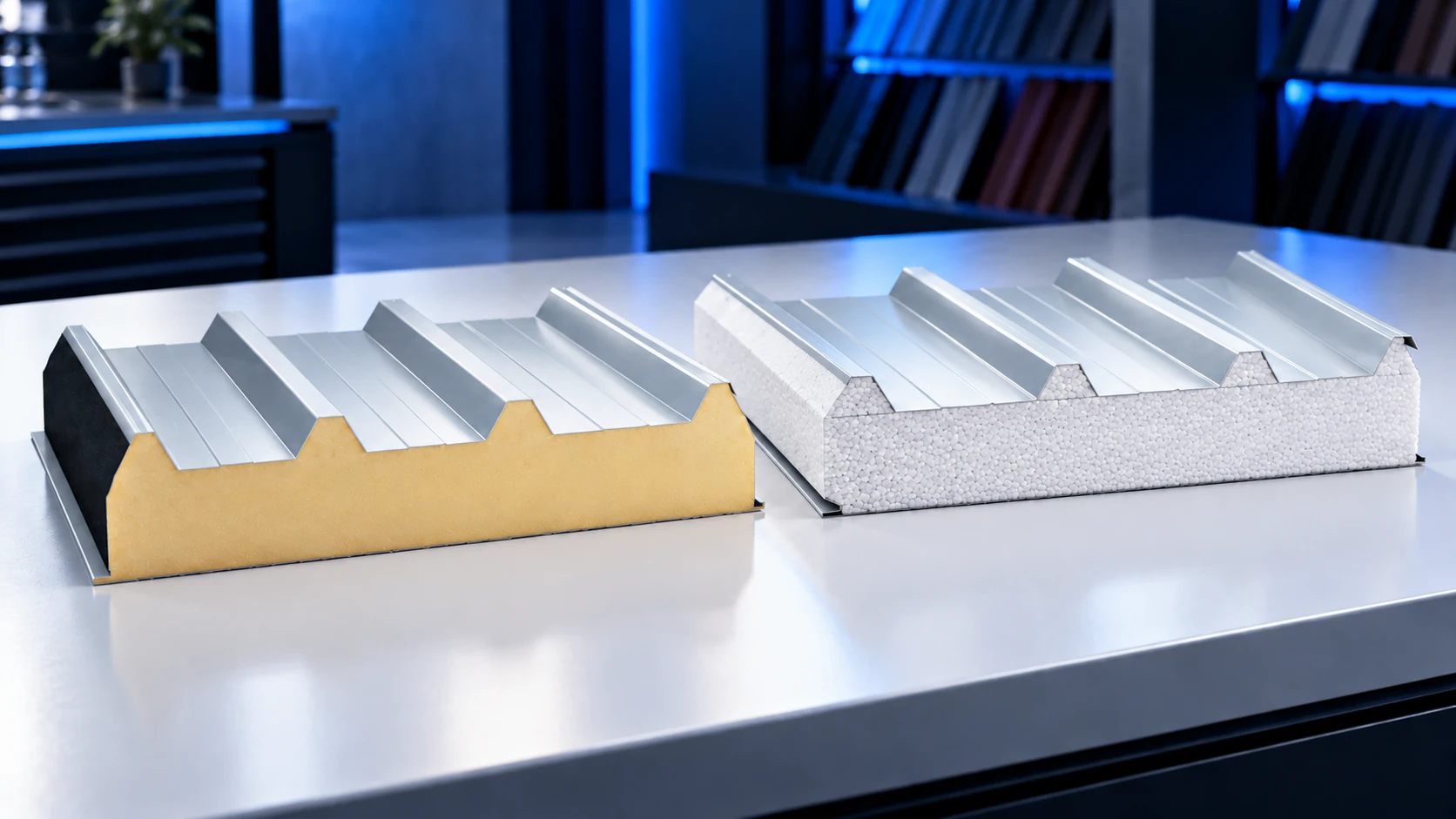
The comparison concerns complete roof panels
Here, the products have outer and inner metal facings with PIR or EPS between them. This is not a comparison between polystyrene below bituminous roofing and PIR foam alone. Such roofs would have different layers and installation methods.
Select two finished roof panels, one EPS and one PIR, and compare their properties in comparable configurations. Do not assume identical load capacity or joint design. Similar-looking steel facings do not mean the panels can be substituted without checking.
What does an equal thickness of 100 mm provide?
Compare PWS-D (EPS) and PWPIR-D (PIR) figures from the 2026 catalogue: the 100 mm EPS panel has a Uc-value of 0.37 W/(m²·K), while the 100 mm PIR panel has 0.21. In this comparison, PIR limits heat transfer more effectively. The figures concern these specific variants, not every panel with that core. Ordering requires data for the selected panels.
A lower panel U-value does not mean the same percentage reduction in heating bills. Heat losses also involve walls, windows, doors and ventilation. Temperature and operating hours matter. Panel data compare one part of the envelope; energy costs require a whole-building calculation.
Also compare options with similar U-values
In a second example, 200 mm EPS has a Uc-value of 0.19 W/(m²·K), while 120 mm PIR has 0.18. These values are close, though not identical. This compares solutions with similar insulation performance. Prices for equal-thickness panels do not always show which roof meets the requirement at lower cost.
If the target is a U-value no greater than 0.15 W/(m²·K), find an actually available variant achieving it. An example PIR panel may reach this at 145 mm. Do not calculate an EPS thickness by a simple conversion and assume it exists. Check the available range and declared data. A result for a hypothetical panel does not establish that it can be ordered and used.
A lighter panel is not necessarily better insulated
Suppose 100 mm panels with 0.5/0.5 mm facings weigh 9.9 kg/m² for EPS and 12.6 kg/m² for PIR. These are figures for example configurations, not complete roofs. The lighter panel does not necessarily insulate better. Compare weight and U-value separately. Structural calculations must include the other loads too.
Lower weight can benefit transport or refurbishment, but it does not establish permissible support spacing. This depends on the interaction of core and facings and the load conditions. Do not infer capacity from foam density alone. The design must account for snow, wind, fixings and the structure supporting the panel.
Assess fire performance from documents for the specific assembly
Reaction to fire, fire resistance and roof performance under external fire exposure are different properties. They are not interchangeable. An example reaction-to-fire class B-s1,d0 does not specify minutes of fire resistance for the complete building element. The relevant assembly classification, including support, fixing and application conditions, is required.
Likewise, Broof(t1) concerns external fire exposure. It does not automatically confirm the same REI fire resistance as another roof. Compare requirements with the full performance of the selected solution. The name EPS or PIR alone does not establish fire-resistance minutes, and classifications must not be transferred between different panel assemblies.
Both alternatives need well-designed junctions
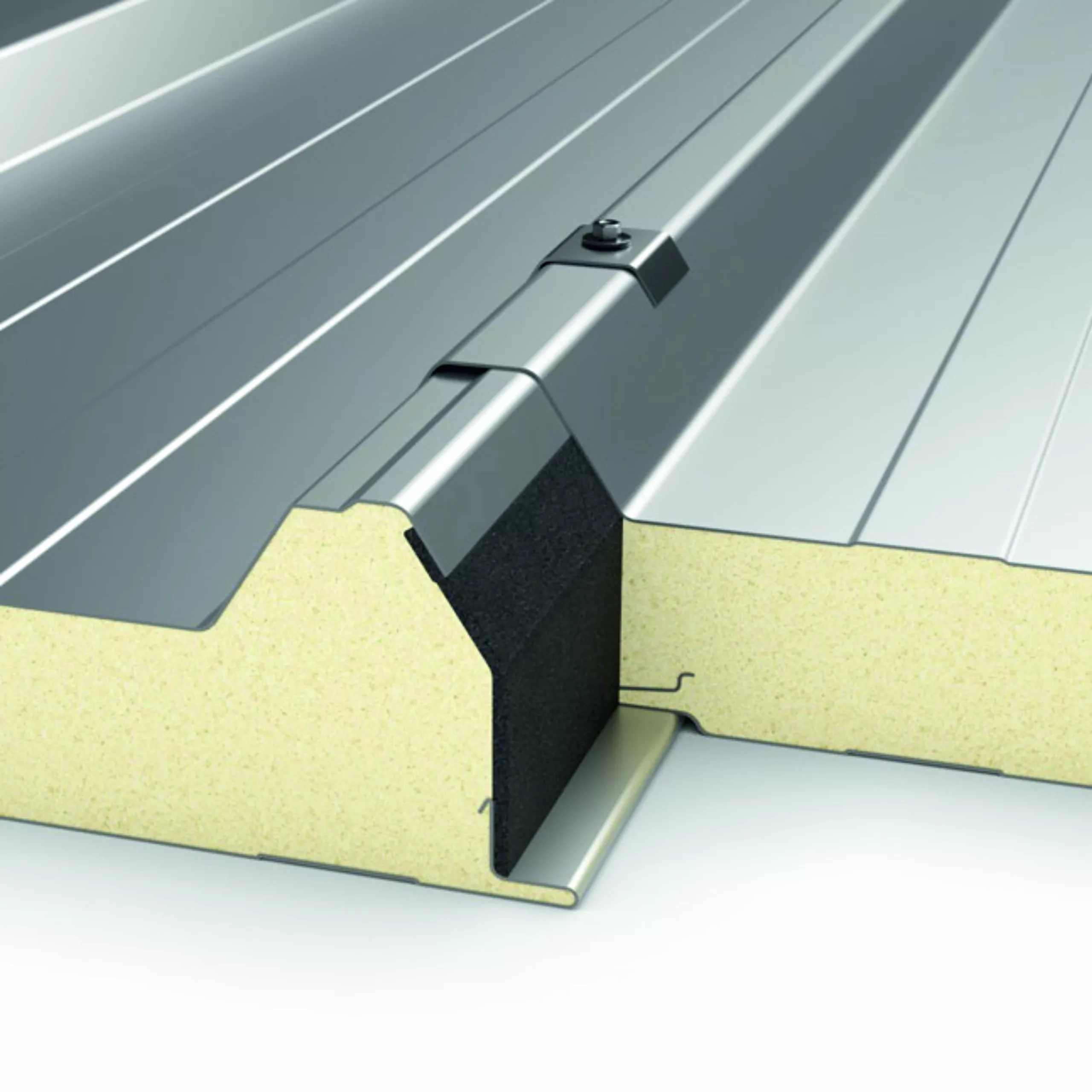
Check the required pitch, laps and roof penetrations. Specify the cutback direction and panel lengths. Do not buy an EPS model as a PIR substitute without checking flashing and joint compatibility.
Review junction details and installation requirements for the selected panels. In agricultural or humid environments, choose suitable coatings too. Protective layers and fasteners matter regardless of core material. Damaged sheet or a leaking joint can undermine good thermal performance. A sound comparison therefore includes these components, their durability and their cost.
When should price decide the comparison?
Only once both options meet the requirements. Then compare complete delivery and installation rather than a single price per m². Include flashings, fixings, transport and any support alterations. Check minimum production quantities and lead time.
There is no basis for a fixed PIR–EPS price difference without current quotations. Delivery terms can strongly influence small orders. PIR is a logical option where thermal performance at limited thickness matters. Consider EPS where the available model meets all design objectives and the complete solution is competitively priced.
Before choosing, check whether the offer concerns new production or warehouse stock. Available lengths and colours may limit the options. Material left from another order needs the same technical assessment as newly produced material. A favourable price does not change its properties or application limits.
Frequently asked questions
Does a 100 mm EPS panel have the same U-value as 100 mm PIR?
Not in this example: the respective values are 0.37 and 0.21 W/(m²·K). Check the properties of the specific variants being purchased.
Will PIR always be cheaper to use?
A lower U-value reduces heat flow, but operating costs depend on the entire building and how it is used.

Free quote
What to include in your enquiry
Tell us how you plan to use the material, the dimensions and the quantity you need. Include the thickness, grade or variant name, along with the delivery town or your preferred collection branch. For a specific product, add its name or a link to the product page. We will reply to the email address you provide to discuss availability and the terms of your order.
More from the building guide
The right PIR sandwich-panel thickness for a garage roof depends first on whether the garage will be heated. Thermal requirements, support spacing…
A retrofit can reduce energy use and retain parts of the existing building if their condition is assessed first. PIR is useful…
Planning PIR insulation should begin by identifying which rooms will belong to the heated part of the house. The roof, a ceiling…
A home can use little energy in operation and still have significant environmental impacts from its materials, maintenance or replacement work. Reducing…
Every centimetre counts when insulating from the inside, particularly in a hallway or under a sloping roof. PIR boards can reduce the…
A livestock building, food store or workshop needs a roof that keeps rain out and limits heat transfer. The underside may also…
A canopy shelters the people on a terrace from rain and sun. If there is a heated room below, the terrace floor…
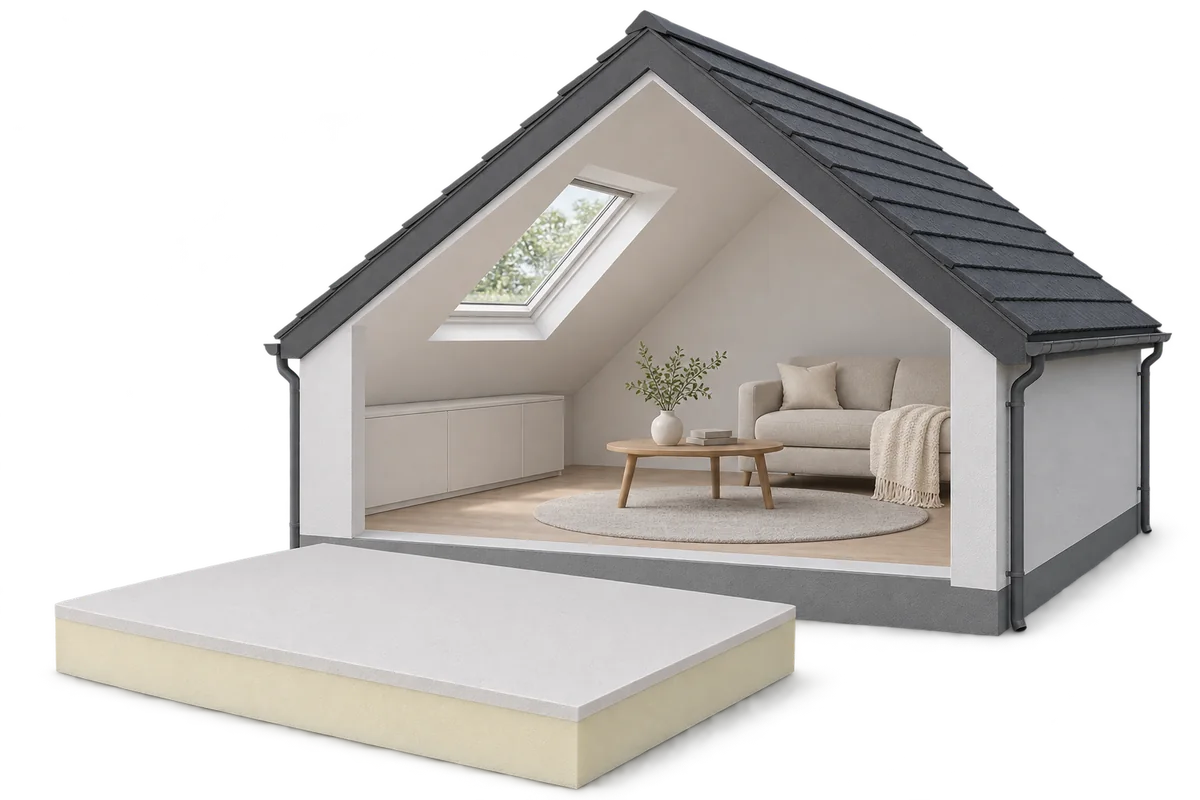
Insulating a loft from the inside can make it more comfortable without taking the roof covering off. PIR bonded to plasterboard provides…