






Is a PIR roof panel fire-resistant? Understanding its classifications
Sandwich panels
A PIR sandwich-panel roof can have a specified fire-resistance classification when built within the conditions covered by its documentation. The PIR core itself is not non-combustible. Check three separate properties: reaction to fire, performance under external fire exposure and the fire resistance of the complete roof assembly. None replaces the others. The exact panel, thickness, supports, fixings and openings must match the relevant scope. This guide explains the meaning and limits of B-s1,d0, BROOF and REI designations, helping you compare a supplier’s documents with the project requirements rather than relying on a general claim that a panel is “fireproof”.
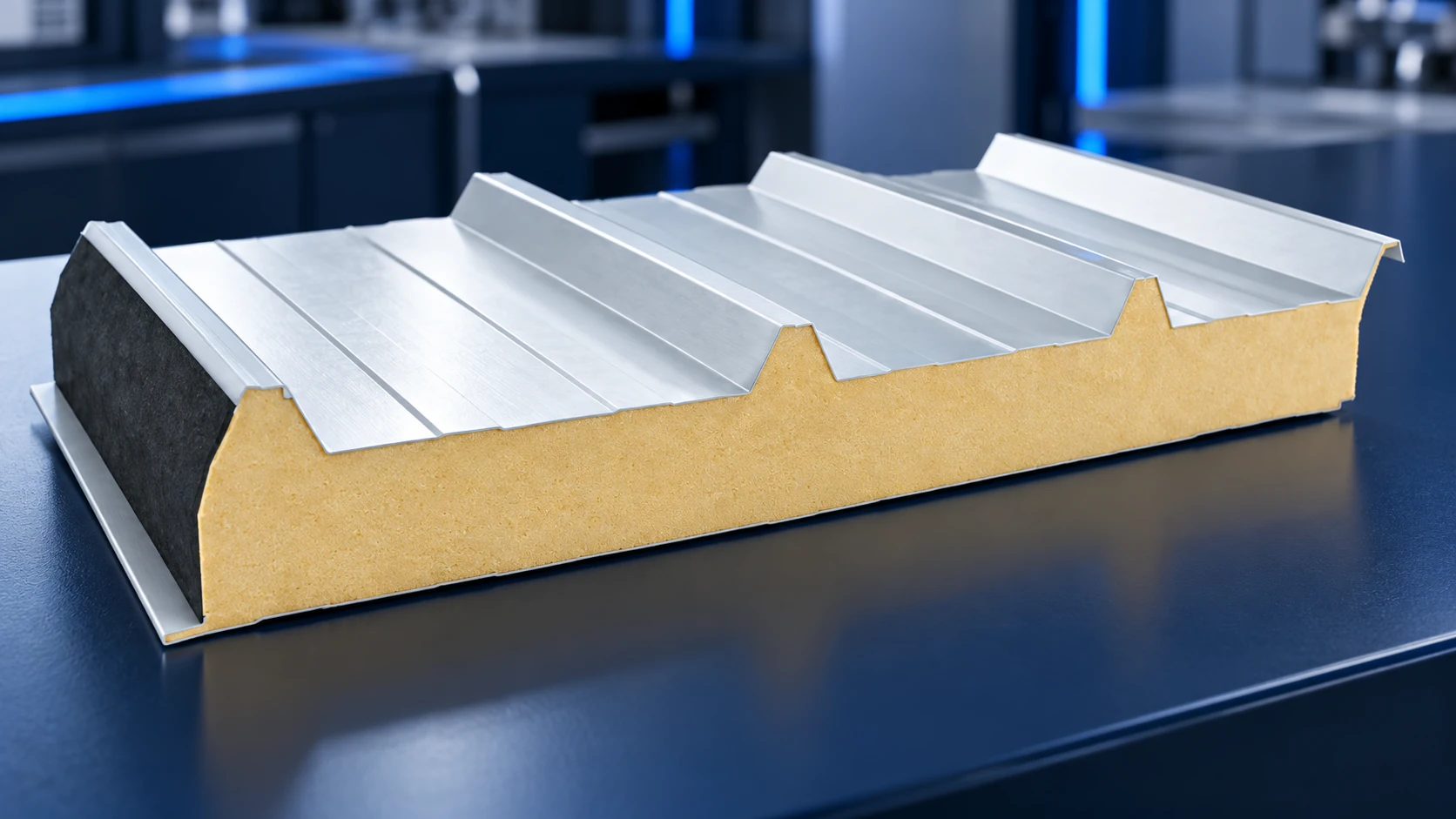
Identify the exact product first
PIR roof panels from different brands and ranges can have different documentation scopes. Thickness, facings and support conditions matter. Do not transfer performance from a wall panel to a roof panel. A similar core name does not establish that the complete solution is equivalent.
An example PIR roof panel may have reaction-to-fire class B-s1,d0 and a separate external-fire classification. The fire-resistance scope of the roof assembly needs another check. These documents must concern the ordered variant and its application. They do not provide a general assurance for all PIR panels. Similar-looking panels need not have the same fire-performance scope.
B-s1,d0 does not mean non-combustible
Class B concerns the product’s reaction to fire. The s1 and d0 designations describe smoke and flaming droplets or particles under the classification conditions. They do not declare that no smoke will occur in every real fire.
Do not call such a panel non-combustible simply because it has steel facings. The assessment concerns the complete product. A metal surface does not automatically change the classification of its core or the entire panel. Use the exact designation in a sales description. It is more useful than vague claims such as “fireproof” or “completely safe”.
BROOF concerns fire exposure from outside
You may encounter B_ROOF(t1), B_ROOF(t2) or B_ROOF(t3). These refer to specific methods of assessing roof performance under external fire exposure. Confirm the appropriate designation for the selected assembly. They are neither a wall’s EI class nor the complete roof’s REI class. Do not assume every PIR roof panel has all these classifications.
Check the designation required by the design and the document’s scope. Do not omit the method suffix and treat all results as one universal property. Roof joints and additions may also matter. An item added later is not covered merely because it is mounted on a panel with documented properties.
REI addresses a different performance requirement
In REI, R denotes load-bearing capacity in fire, E integrity and I insulation. The number refers to time within the relevant classification. It is not a promise for any arbitrarily assembled roof under every fire condition.
The full scope is needed: product, thickness, support arrangement, loads and fixing method. Conditions must match the proposed roof. Do not extend a thicker variant’s classification to a thinner one yourself. A similar joint or identical colour does not demonstrate equivalence. A change to any relevant condition needs checking.
Rooflights and penetrations need particular attention
A roof is more than its panel field. It includes edges, ridge, rooflights and service openings. These must be detailed in accordance with the design. Cutting an opening in a completed roof may alter support conditions and building-element performance. It is not a neutral cosmetic change.
Manufacturers’ instructions require opening details and correct installation to be established. Where fire requirements apply, use the specified seals and accessories. Universal foam does not prove a penetration’s fire resistance. Likewise, extra rooftop equipment needs assessment of its connections and loads; the panel’s own properties cannot be assumed to cover everything.
Check the quotation before buying
Request current technical data and documents for the ordered variant. Compare them with the design requirements. List reaction to fire, external-fire performance and roof fire resistance separately. If the quotation says only “fireproof”, it needs more detail.
The roof after a change of use
At handover, check panel identification. Keep accessory records and documentation of the connections. If a product substitution is needed, assess the complete set of requirements. Do not select the best property from one data sheet and the remaining properties from another. Without a consistent specification, the actual installed roof’s performance cannot be confirmed.
Return to these documents when the building’s use changes. A new process, additional equipment or a different room layout may change the requirements. Do not assume a roof selected once suits every future use of a hall. Assess the current condition and actual equipment, not just the panel name on the invoice.
Frequently asked questions
Does B-s1,d0 mean a non-combustible material?
No. A PIR panel should not be described that way. The designation specifies the finished product’s reaction to fire.
Does BROOF replace REI?
No. It concerns a different form of fire exposure and different assessment criteria.
Does every PIR roof-panel thickness have the same fire-performance scope?
Do not assume so. Check the particular variant and the classification conditions for the complete assembly.

Free quote
What to include in your enquiry
Tell us how you plan to use the material, the dimensions and the quantity you need. Include the thickness, grade or variant name, along with the delivery town or your preferred collection branch. For a specific product, add its name or a link to the product page. We will reply to the email address you provide to discuss availability and the terms of your order.
More from the building guide
A green roof can form part of a nursery retrofit. The structure must support the full build-up and the insulation must be…
A loft fit-out starts well before the first plasterboard goes up. Inspect the roof, plan the insulation and establish how the layers…
PIR wall-panel thickness should follow the building's internal temperature, required U-value and support arrangement. Price alone is not a sound selection method…
A canopy shelters the people on a terrace from rain and sun. If there is a heated room below, the terrace floor…
After insulating a home, check both energy consumption and the cost of purchasing it. A lower bill alone does not prove that…
A home can use little energy in operation and still have significant environmental impacts from its materials, maintenance or replacement work. Reducing…
When damp repeatedly appears at home, gather organised observations before choosing a repair. A mark beside a window, a wet corner and…
A north-facing wall is not inherently damp. Problems arise when a cold surface combines with excess indoor moisture or water entering the…