






Measuring a replacement flashing: folds, angles and coated face
Sheet metal flashings
A single photograph rarely gives a fabricator enough information to replace an unusual roof flashing. Perspective alters the proportions, and an old piece may already be bent. Supply a dimensioned cross-section and describe where the flashing sits on the building. Identify the chimney, eaves, wall, corner or parapet and show where water arrives and where it should leave. Two similar-looking angles can serve very different purposes. A drawing checked against the actual junction gives the fabricator the shape required on site and avoids reproducing accidental dents or earlier alterations.
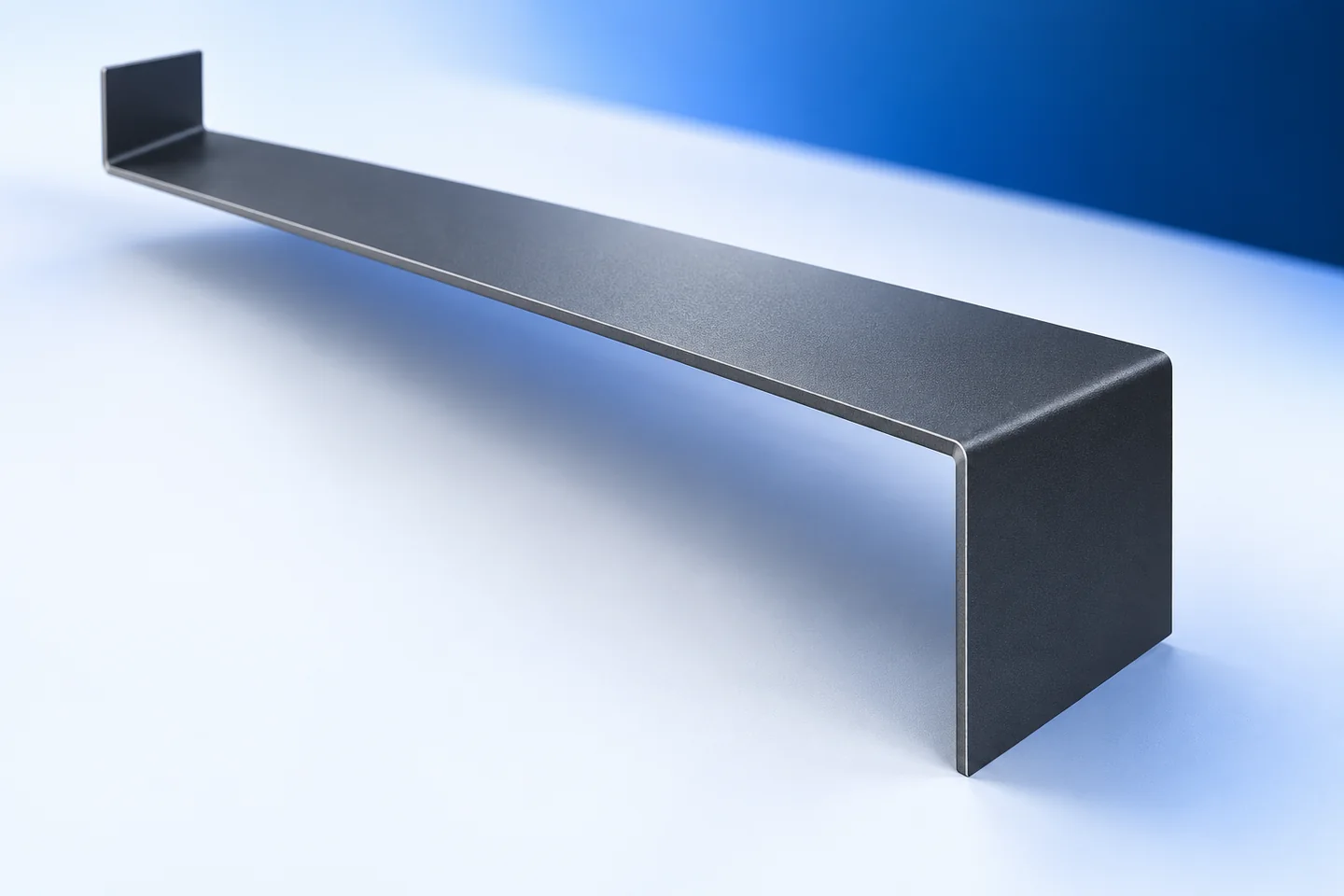
Describe the position and function
Include photographs of the adjoining covering and the ends of the flashing. Photograph a chimney from several sides and a verge at both ridge and eaves. Have a suitably equipped professional measure areas that cannot be reached safely.
Draw the section as an end view
Show the flanges, folds and hems in sequence. State the units clearly. Millimetres are convenient for folded sheet. Mixing centimetres and millimetres without labelling them can turn a small return into a flange that will not fit.
State whether each critical dimension is internal or external. Record the length of the piece separately from the cross-section and include the quantity. Give left- and right-handed pieces distinct references so that their opposite folds are clear.
Check old bends against the building
Wind, handling or an earlier repair may have altered the angle of the loose piece. Check ridge caps against the two slopes and gutter aprons against the eaves and gutter. A detached sample alone cannot show how the components meet.
Correct a short or narrow flashing by revising the junction dimensions. Extra width on every flange can obstruct the covering, ventilation path or fixings. Resolve uncertain dimensions with the installer before approving the drawing for manufacture.
Show the angle and visible face
The bend angle affects both seating and drainage. A description such as “roughly square” gives little guidance for an existing joint. Mark whether the figure is the included angle. A short trial piece can confirm a difficult measurement before the full run is ordered.
Mark the coated face with an arrow. The reverse of colour-coated sheet may have a different finish. A reversed fold can expose it on a starter strip, a window surround or a flashing viewed from below. Label the face on the drawing in its installed orientation.

Specify material and length on the same sheet
Specify the base material, thickness and finish. Galvanised, aluminium-zinc coated and colour-coated sheets have different protective layers. Compare the chosen sheet with what will remain on the building. Identify an unknown existing material before selecting its replacement.
Set the section lengths to suit laps, access and handling. A long piece may be awkward on a small roof and needs protection against bending in transit. If the flashing is divided, plan the joints so their openings do not face the incoming water.
Approve the drawing and trial-fit the sample
Give the drawing a number or date. Mark the agreed revision and keep corrected dimensions in a single legible document. A handwritten change passed on separately can easily miss the version used at the folding machine.
For a complex section, fit a short sample against the actual covering without forcing it. Confirm the remaining quantity once it fits. On delivery check section shape, lengths and surface condition. The trial fit reduces the need to bend the finished coating again on site.
Questions and answers
Do I need to calculate the flat blank width?
Provide the finished cross-section. The fabricator should confirm the developed width using the thickness, bend radii and folding process.
Can the old piece be used as a pattern?
Yes. Mark any damage and check its fit against the building so the fabricator knows which dimensions and bends to reproduce.
Is a photograph with a tape measure enough?
It helps, but perspective can obscure angles and lengths. Supply site photographs together with a dimensioned end view.

Free quote
What to include in your enquiry
Tell us how you plan to use the material, the dimensions and the quantity you need. Include the thickness, grade or variant name, along with the delivery town or your preferred collection branch. For a specific product, add its name or a link to the product page. We will reply to the email address you provide to discuss availability and the terms of your order.
More from the building guide
A hipped roof over a rectangular house usually has two trapezoidal and two triangular slopes joined by a ridge and hips. The…
Dark marks below a gutter do not necessarily mean that the gutter leaks. Water can reach the fascia if the roof covering…
Assess an external steel window sill as part of window drainage, not simply as a coloured façade accessory. Low weight, made-to-measure dimensions,…
Checking flat roof drainage should cover water travelling across the roof, entering the pipework and using the emergency route. The presence of…
A damp corner in the loft or a stain on the bargeboard is a reason to inspect the verge, where the roof…
Calculate a roof budget for a complete scope of work, rather than for sheets alone. Start with actual roof-slope areas, allowing for…
The scope of renovation of a nursery's green roof should cover the structure, thermal insulation, protection against water and roots, and later…
A sandwich-panel roof costs more than the panels alone. Flashings, fasteners, seals, transport and installation must be included, while the supporting structure…