






Mineral-wool sandwich panels: advantages, limitations and comparison with PIR
Sandwich panels
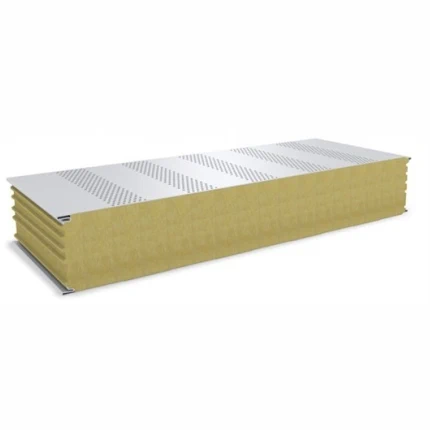
Mineral-wool sandwich panels have useful strengths, but they are not the best option for every application. Selection should start with the building’s requirements and compare specific products, often against PIR panels. Core thickness alone does not make two options equivalent. This guide uses example fire, acoustic, thermal and weight figures to show what a meaningful comparison involves. The figures describe particular variants rather than every panel on the market. Assess the complete wall, including supports, fixings, coatings, installation and operating conditions. Comparing two compliant cladding solutions is more useful than ranking materials by the price of one arbitrarily chosen thickness.
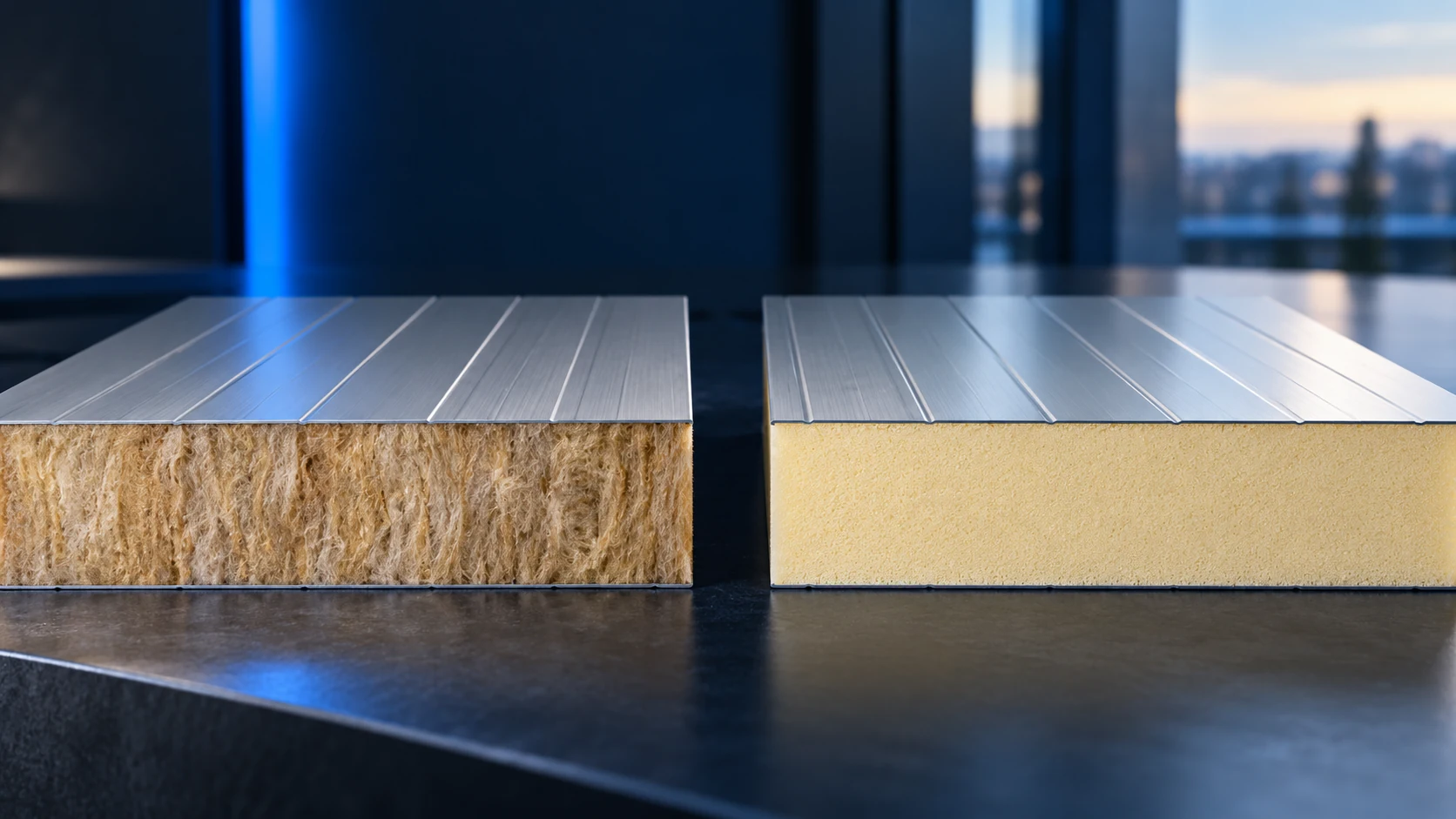
A strength: reaction-to-fire performance
Mineral-wool panels include products with reaction-to-fire class A2-s1,d0. This is a property of a specified product and must be confirmed when buying. It is not the same as the duration of a wall’s fire resistance. The required EI class depends on the complete solution, including the panel and how it is installed.
Mineral wool may be justified in a design with demanding fire requirements. Supports, span and fixings still need checking, as do service penetrations. Placing a non-combustible core between two steel sheets does not remove the need for the other details. A declared property applies only when the installed assembly falls within the documentation’s scope.
Acoustic performance may improve, but compare the figures
Consider two example products: a mineral-wool wall panel with Rw 33 dB and a PIR panel with Rw 26 dB. This shows an advantage for the wool panel in that particular pair. It does not mean every mineral-wool panel has the same advantage over every PIR panel. Read the values for the thickness and construction being ordered.
In a completed building, gates, doors, joints and sound transmitted by other paths also matter. Rw does not describe room reverberation. If machinery noise is the problem, establish its characteristics before choosing the wall. Otherwise money may improve a property that does not address the main source of disturbance.
A limitation: more thickness for the same thermal target
An example 100 mm mineral-wool panel has U = 0.39 W/(m²K), while the compared 100 mm PIR panel has U = 0.22 W/(m²K). A lower value means less heat transmission under otherwise equal conditions. In this pair, PIR insulates better at the same thickness. These figures are not fixed properties of every product in either material group.
Where the design sets a thermal target, compare versions that meet it rather than just two prices for 100 mm panels. Thicker wool changes weight, flashing widths and fastener lengths. What looks like a simple material comparison becomes an assessment of the whole wall solution.
A limitation: greater weight
In the example, the 100 mm mineral-wool panel weighs 18.1 kg/m² and the 100 mm PIR panel 12.3 kg/m², both with 0.5/0.5 mm facings. Across 100 m², the difference is 580 kg. This calculation applies only to those two variants and excludes the structure, flashings and fixings. Different steel facings or core versions change the result.
Greater weight does not rule out mineral wool, but it must be included in design and work planning. The weight of each panel matters, not just the total delivery. Lifting long panels requires planning. Unloading instructions specify appropriate support and protection for facings and edges.
Tightness and durability require careful workmanship
Mineral-wool panels need properly finished ends. Water must not reach the core through damaged joints or flashings. Tightness remains important for PIR panels too. No core material excuses incorrect installation. The manufacturer’s details and the cladding design provide the basis.
Compare documentation availability, coatings and maintenance requirements when buying. Do not assume in advance that mineral wool is always more expensive: price depends on the model, order and delivery scope. A reasoned design may use wool in one part of a building and another system elsewhere. That choice must follow the design rather than an arbitrary substitution.
How to compare costs
Separate purchase costs from operating costs. The first include panels, transport, lifting and accessories. The second include heat losses and surface maintenance. Even a simple comparison needs common assumptions: the same wall area does not necessarily perform the same function.
Do not calculate savings from a better U-value without temperatures and heating periods. An unheated warehouse differs from a hall heated throughout the year. A fire-performance advantage likewise has value in relation to specific requirements; it cannot be assigned a universal price per square metre.
Ask for two complete cladding alternatives, each meeting the project’s requirements. Then compare totals and the work involved. This is a fairer assessment than ranking materials solely by the price of a panel at an arbitrarily selected thickness.
Frequently asked questions
Does mineral wool always provide better acoustics than PIR?
That cannot be generalised. Compare results for the exact panels and account for the whole wall assembly.
Will a thicker mineral-wool panel meet every requirement?
No. Fire performance, supports, fasteners, exposure conditions and installation still need to be checked.

Free quote
What to include in your enquiry
Tell us how you plan to use the material, the dimensions and the quantity you need. Include the thickness, grade or variant name, along with the delivery town or your preferred collection branch. For a specific product, add its name or a link to the product page. We will reply to the email address you provide to discuss availability and the terms of your order.
More from the building guide
Plan a sandwich-panel commercial building around the work taking place inside, rather than starting with façade colour. Temperature, doors, washing, noise and…
Supplier reviews can help assess service, but they do not replace checking the material being purchased. Separate product quality from transport, advice…
Choose roof sandwich-panel thickness by checking the building's internal conditions and thermal target first, then structural capacity, joints and the scope of…
The cost of a sandwich-panel hall depends on the scope of the project. A frame with cladding is a different purchase from…
No single screw suits every mineral-wool sandwich panel. The fastener must match panel thickness, support material and the loads on the connection;…
After a sandwich panel home is completed, the owner needs information about the envelope actually installed, its connections and its care requirements.…
Roof sandwich panels can be used in an extension where the existing structure and new design permit them. Their relatively low weight…
An old warehouse can often be adapted to store potatoes without building a new hall. Three things must work together: an airtight…