






150 or 200 mm mineral-wool wall panels: heat loss, weight and fire performance
Sandwich panels
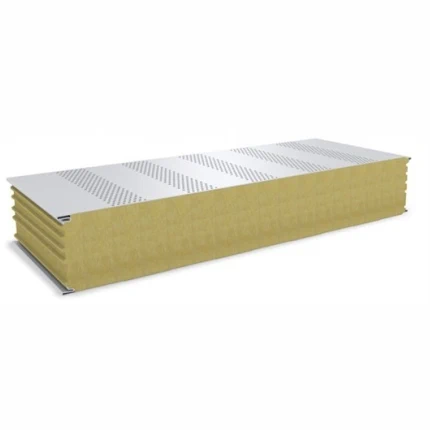
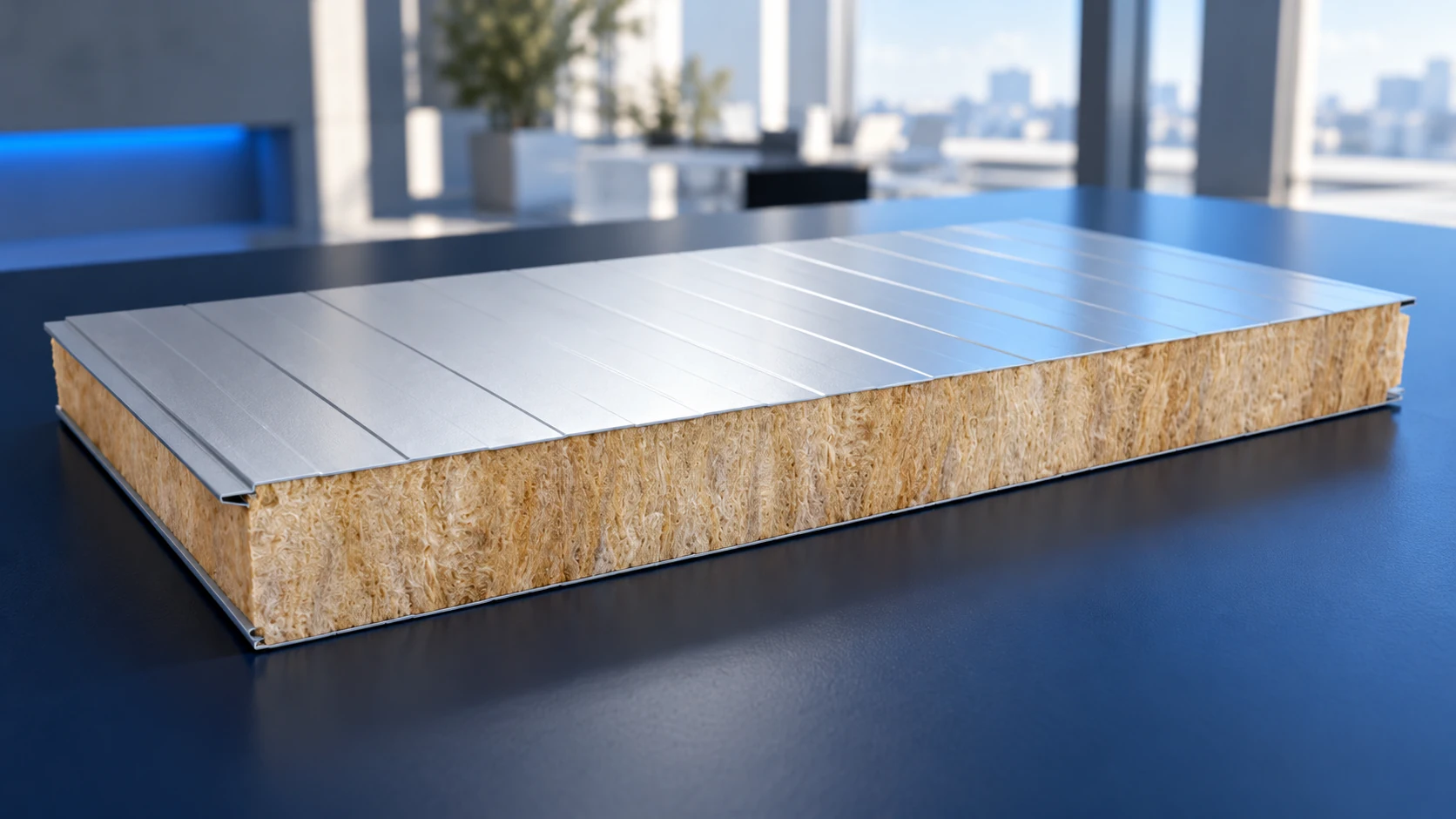
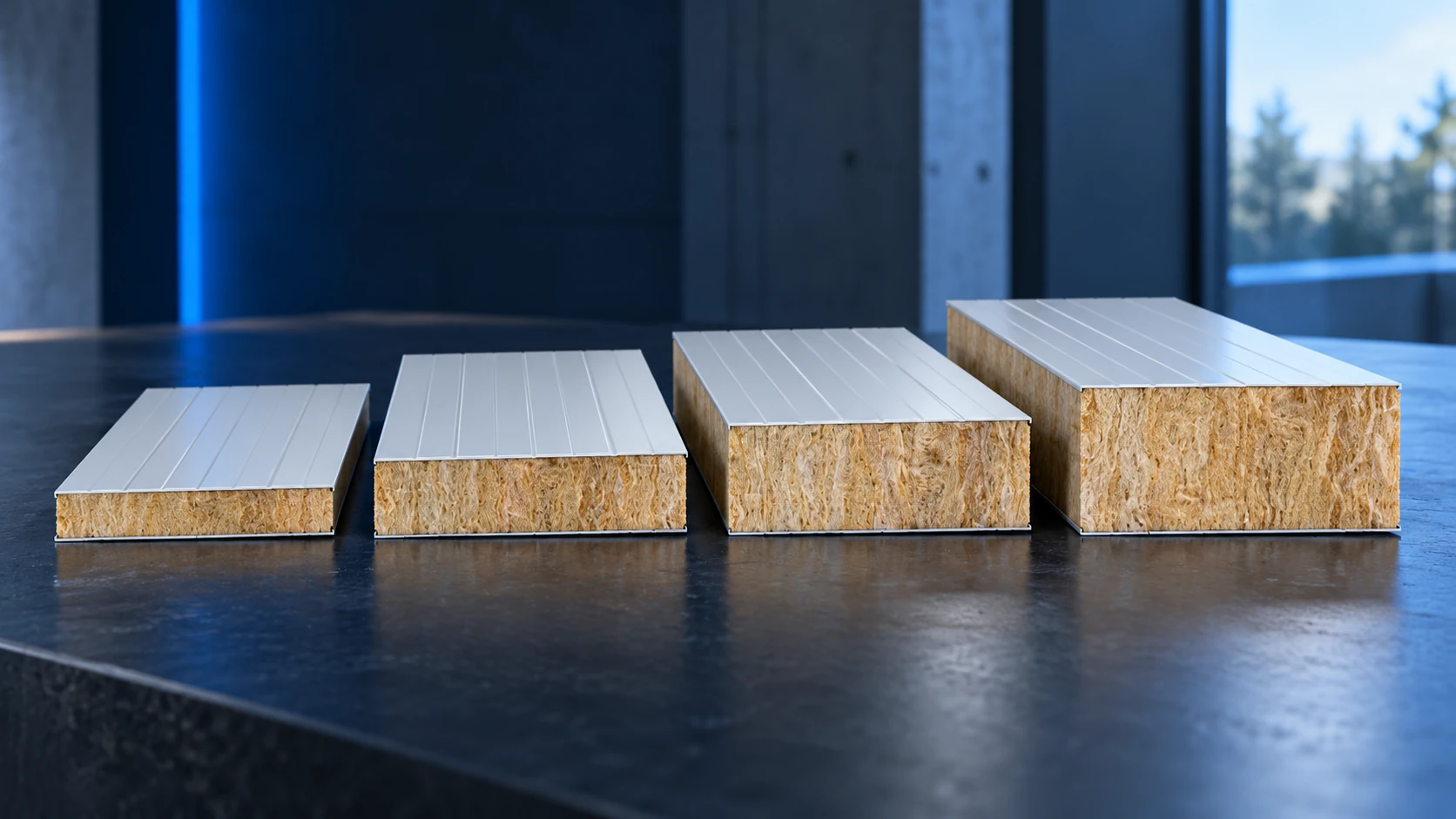
A 200 mm mineral-wool wall panel reduces heat flow more than a thinner version of the same model, but also weighs more. Thickness alone does not guarantee the highest fire-resistance class or represent the thickest insulation available. Choosing between 150 and 200 mm requires the wall’s thermal target, structural checks and the complete project requirements. This guide compares example U-values and weights, demonstrates the limited meaning of a heat-flow calculation and identifies changes to fixings and flashings. Treat the figures as product-specific examples. A percentage reduction through the panel field is not the same as a percentage saving on the building’s heating bill.
Start with specific figures
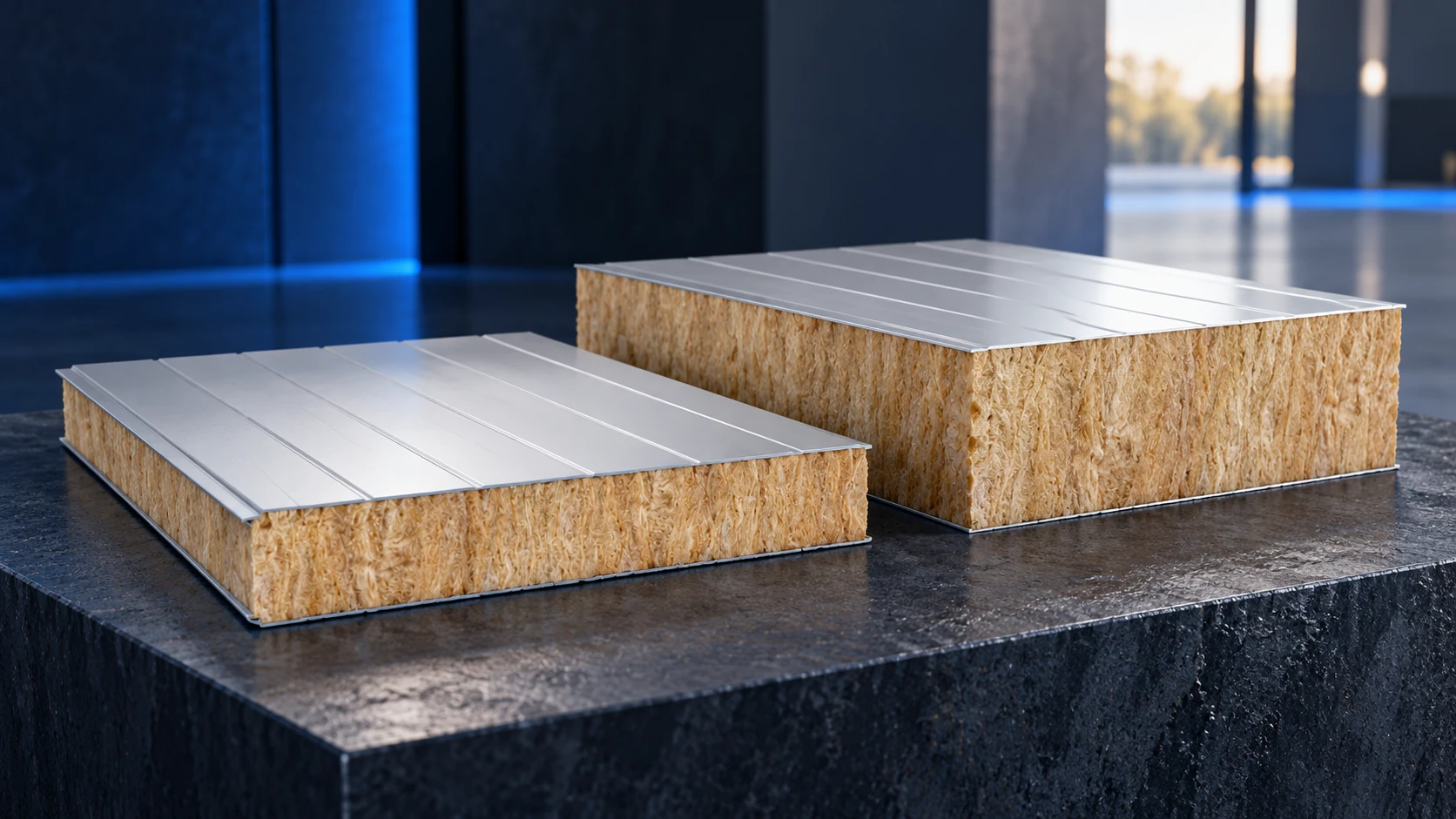
One example 150 mm mineral-wool panel has U = 0.27 W/(m²K) and mass 23.1 kg/m²; its 200 mm variant has U = 0.20 W/(m²K) and mass 28.1 kg/m². The weights assume 0.5/0.5 mm facings. These are figures for one product family, not every panel of those thicknesses.
A second example uses variable-density mineral wool. At 150 mm, U = 0.25 W/(m²K) and mass 21.3 kg/m²; at 200 mm, U = 0.19 W/(m²K) and mass 25.6 kg/m², with 0.5/0.5 mm facings. Different construction produces different results. Do not combine one variant’s weight with another’s insulation performance.
What the U-value difference means in practice
At equal area and temperature difference, heat flow is proportional to U. For a 100 m² panel field and a 20 K temperature difference, U = 0.27 W/(m²K) gives 540 W; U = 0.20 W/(m²K) gives 400 W. The difference is 140 W under these specified example conditions.
This does not predict whole-building savings. It excludes thermal bridges and details not covered by the declared Uc, plus windows, ventilation and heating duration. Do not count joint effects twice if already included in the manufacturer’s data. The calculation only compares heat flow through a defined panel field; energy consumption requires additional building and operating data.
The ratio 0.20/0.27 is approximately 0.74, indicating around 26% less heat flow through the compared panel field under equal conditions. State this fully rather than claiming “26% savings”, which ignores the rest of the building. Evaluating a price premium also requires heating duration, temperatures and other heat-loss paths.
Allow for the additional weight early
In the first example, changing from 150 to 200 mm adds 5 kg/m², or 500 kg across 100 m². This does not automatically require rebuilding every frame, but it must be checked against the assumed loads. Repeat the calculation for any different product.
Check the mass of each panel too. Long elements may need a different lifting method. Transport instructions cover edge protection and package support. Include equipment and installation time in the estimate: the extra panel price per square metre does not show the full effect of greater thickness.
Fire performance is not just a matter of centimetres
Thickness is one condition of fire classification; panel type, installation direction, span and fixings also matter. Do not promise a universal EI class for every 150 or 200 mm mineral-wool wall. Reaction-to-fire class A2-s1,d0 describes a different property from the complete wall’s fire resistance.
Request the current classification scope for the planned wall. Public data sheets and instructions may show different ranges; do not choose the more favourable figure without clarification. The document must match the project and ordered product, including seals and opening details.
Thicker panels also change flashing details
Check base width, window surrounds, corners and junctions with existing buildings. Greater thickness can shift the façade face and change fastener selection. Coordinate these details before ordering.
During refurbishment, space around doors is particularly important. Old flashings may not cover the new termination. Do not leave the core exposed or improvise with unrelated sheets. Correct details determine tightness; thicker insulation cannot compensate for a faulty edge closure.
When to choose 150 mm and when 200 mm
The 150 mm option may suffice if it meets thermal and other requirements. Consider 200 mm where a lower U-value is needed. Check both against load tables and fire documentation rather than assuming thicker is always better.
200 mm is not a universal upper limit for mineral-wool panels. Product families have different ranges; confirm availability before ordering. The useful question is which thickness the building needs, not which is the thickest panel available without considering its other properties.
Frequently asked questions
Does 200 mm always provide the highest EI class?
No. Fire resistance depends on the complete classified assembly, including supports, orientation and fixings.
Will a 26% lower U-value cut heating bills by 26%?
No. That change concerns heat flow through the compared panel field. The building also has other heat losses.

Free quote
What to include in your enquiry
Tell us how you plan to use the material, the dimensions and the quantity you need. Include the thickness, grade or variant name, along with the delivery town or your preferred collection branch. For a specific product, add its name or a link to the product page. We will reply to the email address you provide to discuss availability and the terms of your order.
More from the building guide
When comparing mineral-wool wall panels, start with the U-value declared for the finished product. Lambda describes the core material's thermal conductivity, not…
A mineral-wool sandwich panel can reduce sound transmission, but the performance belongs to the specific product, not the core material alone. Distinguish…
Attic insulation works when it forms a continuous layer and the entire roof manages moisture and air leakage. A thicker board cannot…
An offer for a 40 mm mineral-wool wall panel needs careful identification: thickness alone does not confirm the core. Some mineral-wool panel…
Wall-panel thickness must satisfy several requirements together: thermal insulation, fire performance, span and weight. Do not start by assuming that 100 mm…
The cost of mineral-wool wall panels depends on the variant, thickness, facings and order size. A price per square metre covers only…
Mineral-wool sandwich panels can be useful where fire performance and efficient cladding installation are important. They may form walls of industrial buildings,…
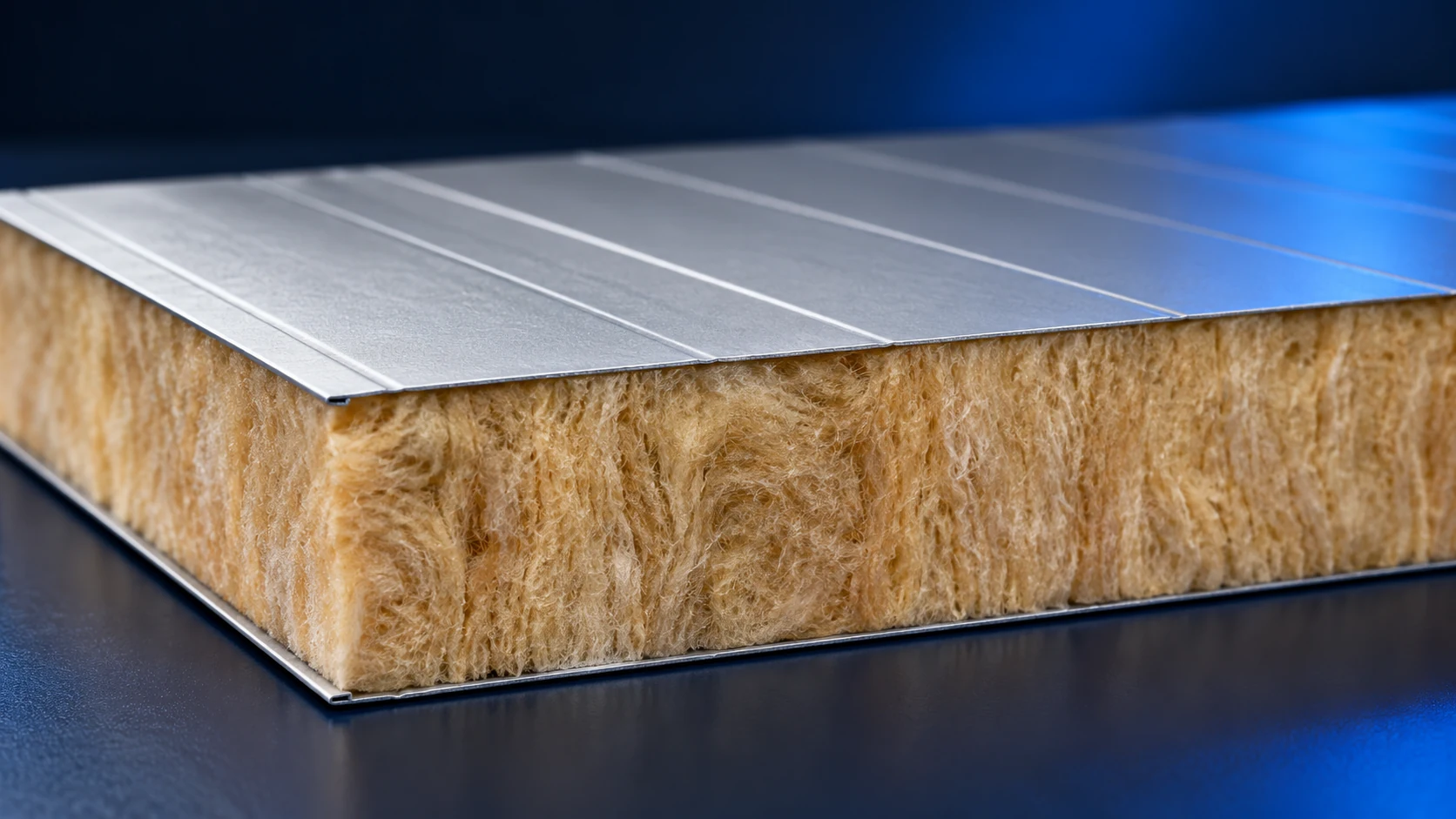
A sandwich wall panel combines an insulating core with two facings. The products discussed here use mineral wool between steel facings and…