






Choosing a mineral-wool wall panel for a specific building
Sandwich panels
The right mineral-wool wall panel is the one that meets the building’s requirements, not necessarily the thickest or most expensive option. Start with the wall’s function, then establish fire, thermal and structural requirements. Compare appearance and price only between products that meet those conditions. This guide explains how to use the finished panel’s U-value, distinguish reaction to fire from wall fire resistance, and account for weight, lifting and coating exposure. A useful quotation must cover the same specification and scope as competing offers. Preparing those details before asking for prices makes it easier to choose a complete, suitable cladding system.
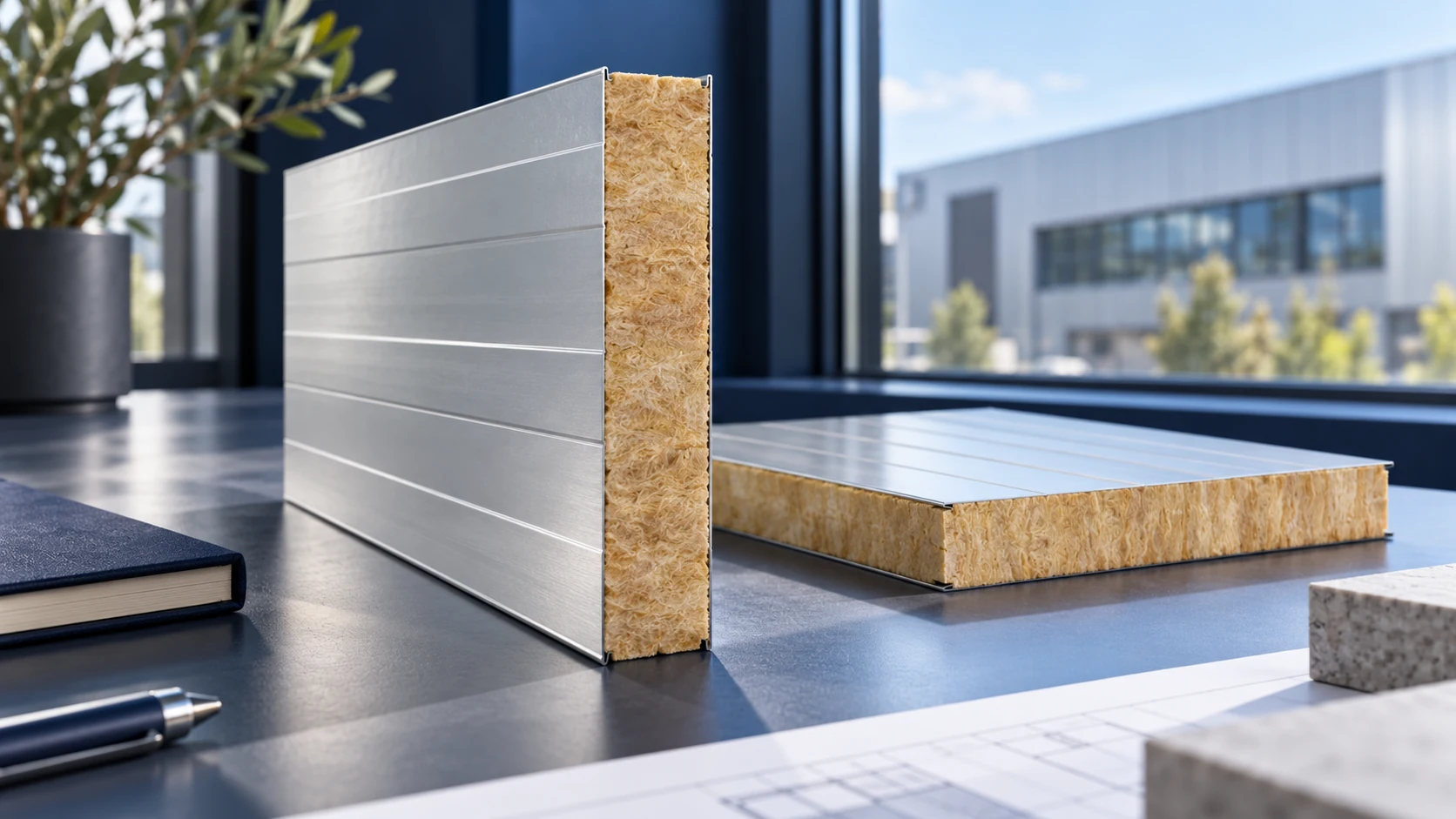
Write down the requirements before discussing price
Prepare a short building description with room uses, temperatures and humidity conditions. Include wall dimensions and the arrangement of columns and rails. Establish whether the wall needs a fire-resisting function. This information affects panel selection far more than the core name alone.
Mineral-wool wall panels may form external cladding or internal partitions. Some products permit vertical and horizontal installation, but that does not mean fixings can be arranged arbitrarily. Relate performance to the actual structural layout. The same panel may need different supports in two buildings. Its intended use must match the design.
Compare the U-value of the finished panel
Lambda describes the core material’s thermal conductivity. U-value describes heat transmission through the panel. Compare the U-value declared for the exact product and thickness. The shared description “mineral wool” is insufficient, since product construction also affects performance.
For example, two 100 mm mineral-wool versions may have U-values of 0.39 and 0.37 W/(m²K). These are figures for particular variants, not a universal property of every panel of that thickness. The difference shows why full specifications matter. Assessing the complete wall also requires its junction details to be considered.
Check fire performance in two separate ways
First check reaction to fire, then the required fire resistance of the wall. These are different properties. A mineral-wool panel may, for example, have reaction-to-fire class A2-s1,d0. That does not assign a particular EI rating to every wall made from it. Fire resistance is confirmed for a complete assembly and defined application conditions.
Assessing EI requires the classification conditions, including orientation, span and fixing method. Junctions at the base, roof and openings must also be resolved. If documents disagree, ask the manufacturer to clarify the applicable scope. Choosing the higher figure in a table is not a design method.
Check weight and installation feasibility
Example 100 mm mineral-wool panels with 0.5/0.5 mm facings weigh 18.1 or 17.0 kg/m²; another version may differ. Weight per square metre alone does not show how easy a panel will be to install. Multiply it by the full panel area and consider the lifting conditions.
For long panels, check vehicle access, unloading and lifting equipment, and agree the delivery sequence. Shorter elements can simplify handling but add joints. Compare both layouts before ordering. Transport instructions explain why length and lifting method are part of product selection, not minor afterthoughts.
Then select the finish and compare offers
Assess environmental exposure on both sides of the wall. Match the coating to chemicals, cleaning and humidity, then choose profiling, colour and fixing type. Dark façades require greater thermal effects to be considered. This decision involves more than a colour sample.
Send the same specification to every supplier. Compare identical facing thicknesses, cores, coatings and delivery scopes. Separate panel prices from transport and accessories. Ask for references to the documents confirming the required properties. This makes a favourable offer identifiable without guessing what a lower price leaves out.
What the enquiry should contain
Prepare one table with the quantity and length of every panel, plus an elevation drawing showing openings. State the required U-value, reaction-to-fire class and wall fire resistance where specified. Give the desired colours on both sides and whether exposed screw heads are acceptable.
Ask which facing thicknesses are available. Two offers with the same core may use different steel sheets, affecting weight and the applicable load tables. Check quantities of tapes, flashings and fasteners too. A panel-only offer does not show the cost of complete cladding. Missing items are not a saving.
Finally, add delivery conditions: address, vehicle access and unloading method. For staged installation, agree the division into bundles. A straightforward sequence plan can avoid repeatedly moving heavy elements.
Frequently asked questions
Does denser mineral wool always make a better panel?
No. The complete product determines performance. Compare declared properties, load resistance and classifications for the exact model.
Can another model replace the specified panel after design approval?
Any substitution requires all specified requirements to be checked. Matching thickness and colour are not sufficient.

Free quote
What to include in your enquiry
Tell us how you plan to use the material, the dimensions and the quantity you need. Include the thickness, grade or variant name, along with the delivery town or your preferred collection branch. For a specific product, add its name or a link to the product page. We will reply to the email address you provide to discuss availability and the terms of your order.
More from the building guide
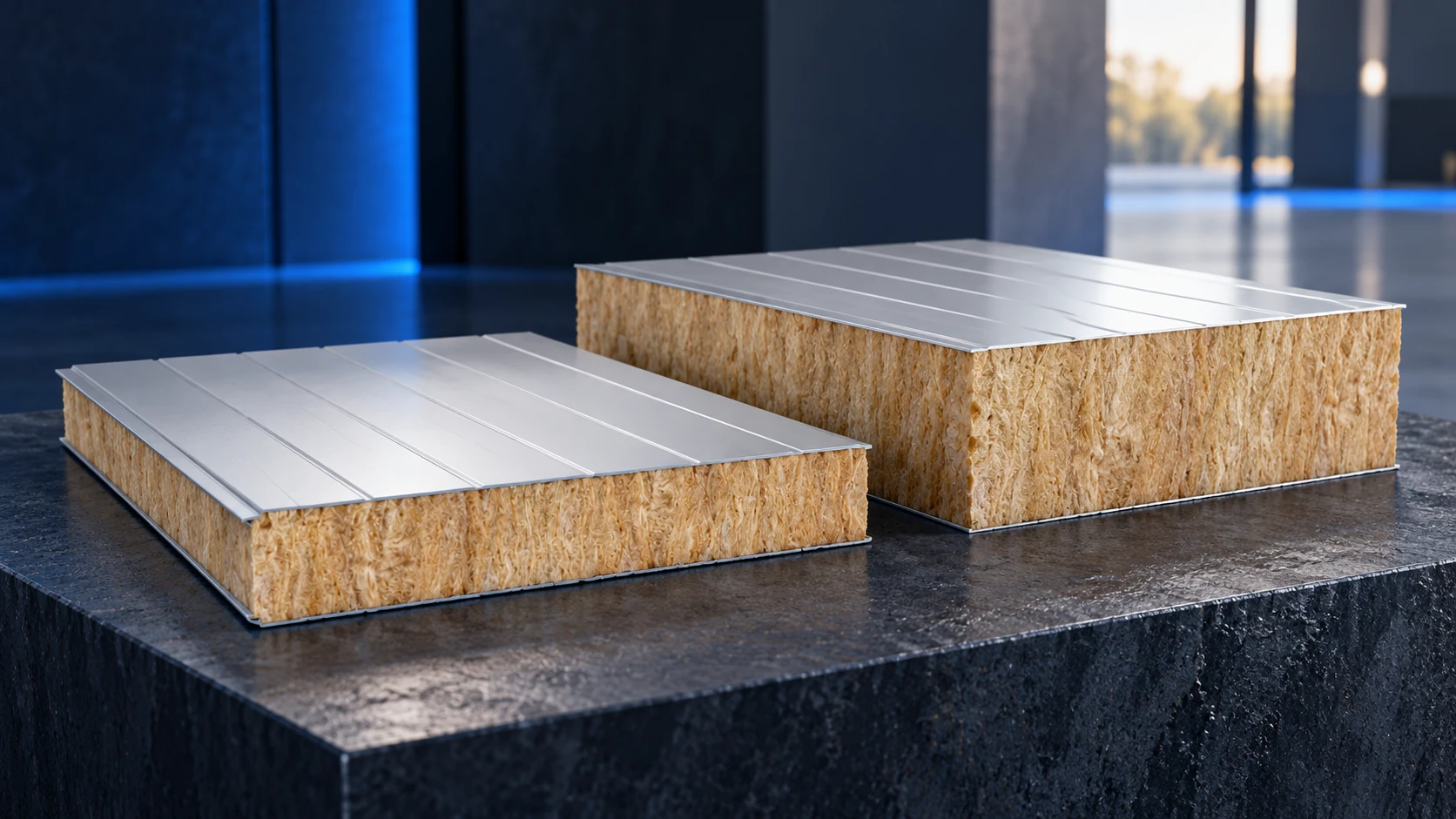
A 200 mm mineral-wool wall panel reduces heat flow more than a thinner version of the same model, but also weighs more.…
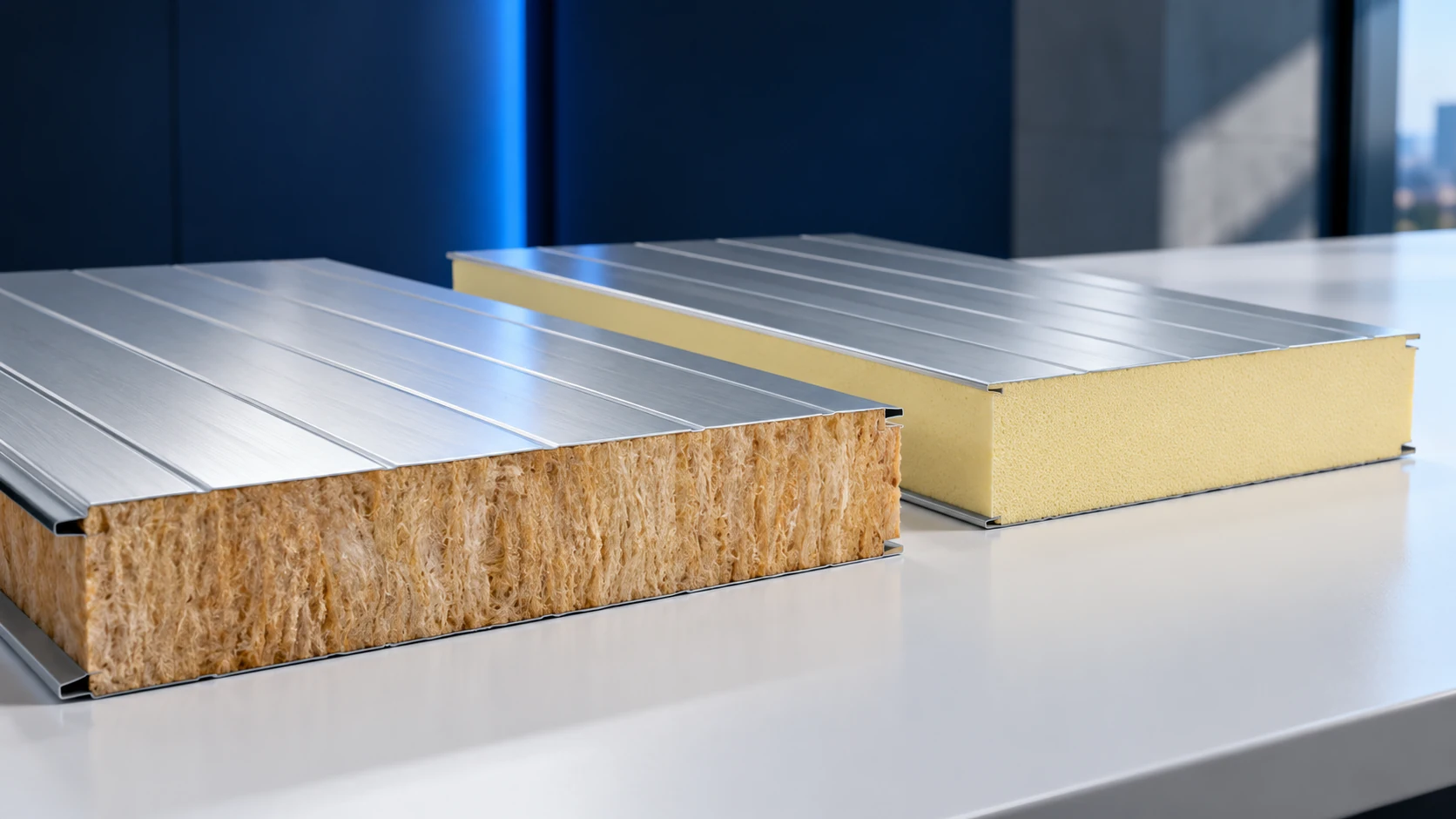
PIR generally achieves a low U-value with less thickness, while mineral-wool sandwich panels may suit particular fire requirements better. Neither is the…
Attic insulation works when it forms a continuous layer and the entire roof manages moisture and air leakage. A thicker board cannot…
Mineral-wool panel weight depends on the model, thickness and both facings; there is no single figure for the whole product group. Planning…
Wall-panel thickness must satisfy several requirements together: thermal insulation, fire performance, span and weight. Do not start by assuming that 100 mm…
Outlet mineral-wool wall panels can reduce cladding costs if the reason for their lower price is understood. Surplus stock and a panel…
When comparing mineral-wool wall panels, start with the U-value declared for the finished product. Lambda describes the core material's thermal conductivity, not…
The cost of mineral-wool wall panels depends on the variant, thickness, facings and order size. A price per square metre covers only…